If you have ever watched a football game, played casually with friends, or seen a field from the stands, you may have wondered a simple question: how big is a football field? The answer sounds straightforward at first, but confusion often follows once people realize that field size depends on what kind of football is being played and which parts of the field are included.
Some people hear that a football field is 100 yards long. Others say it is 120 yards. Some talk about meters instead of yards. Then there are markings, end zones, sidelines, and safety areas that further complicate the picture. For beginners, parents of young athletes, students, and casual fans, this can quickly become overwhelming.
Understanding football field dimensions matters more than you might think. It helps viewers follow the game, allows players to visualize strategies, and gives context to statistics, records, and athletic performance. This article explains football field size clearly, step by step, using plain language and real-world comparisons so anyone can understand it without prior knowledge.
What Type of Football Are We Talking About?
Before discussing measurements, it is important to clarify which version of football we mean. Around the world, the word “football” can describe different sports.
In this article, the focus is on American football, which is played in leagues such as the NFL, college football, and high school football. This is the version with end zones, yard lines, and downs. While soccer fields (often called football pitches internationally) vary greatly in size, American football fields follow a standardized layout, especially at higher levels.
The Standard Length of a Football Field
The Playing Field: 100 Yards
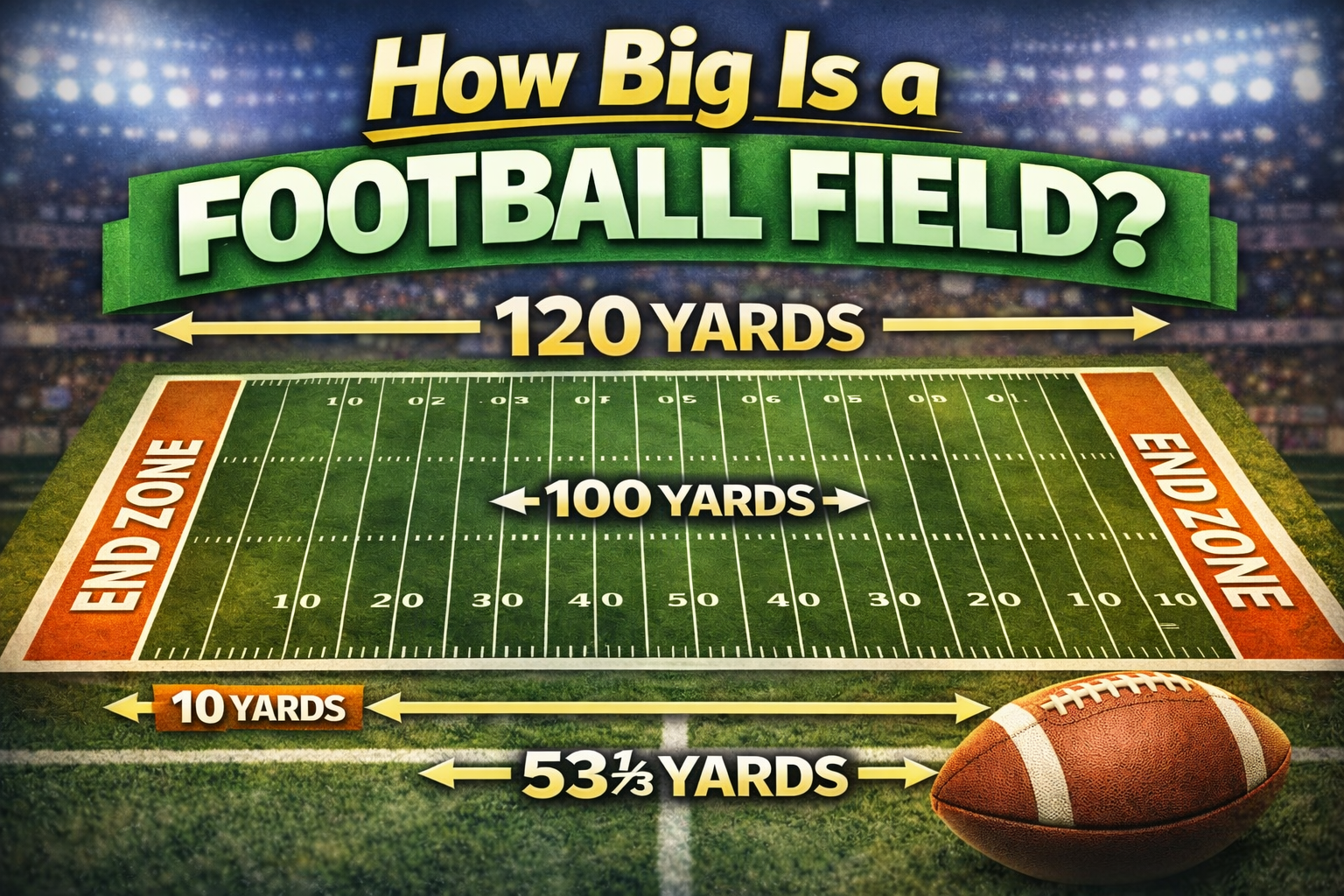
The main playing area of an American football field is 100 yards long. This is the distance between the two goal lines where most gameplay occurs.
To make this easier to picture:
- 100 yards equals 300 feet
- That is roughly the length of a city block
- It is slightly longer than a standard soccer field’s shortest allowable length
This 100-yard distance does not include the end zones, which are separate areas at each end of the field.
Including the End Zones: 120 Yards Total
Each football field has two end zones, one on each end. Each end zone is 10 yards deep.
When you add these together:
- 100 yards (playing field)
- 10 yards (one end zone)
- 10 yards (other end zone)
- = 120 yards total length
In feet, that equals 360 feet from the back of one end zone to the back of the other.
This is why you will often hear both numbers used. When people say a football field is 100 yards long, they are referring to the main playing area. When they say 120 yards, they are including the end zones.
How Wide Is a Football Field?
Official Width: 53⅓ Yards
The width of a standard American football field is 53⅓ yards, which equals 160 feet.
This width is consistent across professional, college, and most high school fields. The sidelines run the full length of the field, creating a rectangular playing surface that allows for wide offensive formations, defensive coverage, and sideline plays.
To visualize this width:
- It is wider than a basketball court
- It is narrower than most soccer fields
- It is roughly the width of 16 parked cars placed side by side
Understanding the End Zones
What Are End Zones?
End zones are the areas where touchdowns are scored. Each end zone measures:
- 10 yards deep
- 53⅓ yards wide, the same as the rest of the field
They are usually painted or decorated with team colors, logos, or names, making them visually distinct from the main field of play.
Why End Zones Exist
End zones serve several purposes:
- They clearly define scoring areas
- They provide space for players to safely complete plays
- They allow officials to judge touchdowns accurately
Without end zones, scoring would be much more difficult to regulate and officiate.
Yard Lines and Field Markings Explained
Yard Lines Every 5 Yards
The field is marked with lines every 5 yards, running across the width of the field. These lines help players, coaches, officials, and fans track field position.
Numbered Yard Markers
Every 10 yards, the yard line is numbered. The numbers increase as teams move toward midfield and then decrease as they approach the opposite end zone.
At the center of the field is the 50-yard line, which marks midfield.
Hash Marks
They indicate where the ball is placed at the start of each play.
The distance between hash marks varies by level:
- Professional fields have narrower spacing
- College fields have wider spacing
- High school fields may differ slightly
These differences affect play strategy, especially for kickers and quarterbacks.
Out-of-Bounds Areas
Beyond the sidelines and end zones, extra space is required for:
- Player safety
- Coaches and staff
- Officials
- Equipment and camera crews
These areas vary by stadium and level of play, but they can add several yards on all sides, making the total footprint significantly larger than the official dimensions.
Does Field Size Change at Different Levels?
Professional Football
Professional fields follow the strictest standards. Dimensions are consistent, markings are precise, and surfaces are carefully maintained.
College Football
College fields use the same overall field size, but small differences exist in:
- Hash mark spacing
- Logo placement
- Sideline depth
Despite these differences, the field remains 120 yards long and 53⅓ yards wide.
High School Football
Most high school fields match the same basic dimensions. However:
- Some markings may differ
- End zone designs vary
- Safety areas may be smaller due to space limitations
Youth and Practice Fields
Youth football fields are often smaller to match player age and ability. These fields may:
- Shorten the length
- Reduce width
- Adjust end zone depth
This helps young players develop skills without being overwhelmed by full-size distances.
How Big Is a Football Field Compared to Other Sports?
Compared to a Soccer Field
Soccer fields vary widely in size, but most are:
- Longer than a football field
- Wider than a football field
This makes soccer fields feel more open and spacious.
Compared to a Baseball Field
Baseball fields have no fixed size, but their playing areas are usually smaller overall, with large outfield spaces in specific directions rather than a uniform rectangle.
Compared to a Track Field
A standard running track often surrounds a football field, which gives a useful perspective. The football field fits neatly inside the oval shape, emphasizing its rectangular structure.
Common Misunderstandings About Football Field Size
“The Field Is Only 100 Yards Long”
This is only partly true. The playing area is 100 yards, but the full field including end zones is 120 yards.
“All Football Fields Are the Same”
While core dimensions are standardized, details like hash marks, sidelines, and surrounding space vary by level and location.
“Soccer and Football Fields Are the Same”
They are very different. Soccer fields vary in size and shape, while American football fields are highly standardized.
Practical Reasons to Know Football Field Dimensions
Understanding field size helps in many real-life situations:
- Parents planning youth sports
- Coaches designing drills
- Students learning the game
- Fans interpreting plays and statistics
- Content creators explaining football concepts
It also improves appreciation for player endurance, speed, and strategy when you realize how much ground is covered during a game.
Frequently Asked Questions
How many acres is a football field?
Including end zones, a football field covers about 1.32 acres. This does not include surrounding safety areas or stadium space.
Can a football field fit inside a soccer stadium?
Yes. Many stadiums are designed to accommodate both sports by adjusting field markings and seating arrangements.
Why don’t football fields change size?
Consistency ensures fairness. Standardized dimensions allow teams to compete on equal footing regardless of location.
Conclusion: A Simple Answer to a Common Question
So, how big is a football field? In simple terms:
- 100 yards long for the main playing area
- 120 yards long including end zones
- 53⅓ yards wide
These dimensions form the foundation of American football at nearly every level. While details may vary slightly, the core layout remains consistent to ensure fairness, safety, and clarity.
Understanding football field size removes confusion, enhances enjoyment of the game, and helps fans and players alike appreciate the physical demands of the sport. Once you know the measurements, every play, pass, and touchdown becomes easier to visualize—and the game makes a lot more sense.