If you’ve ever watched a football game and seen a referee throw a yellow flag just as the ball arrives near a receiver, there’s a good chance pass interference was the reason. It’s one of the most discussed and sometimes controversial penalties in football. Fans often debate whether the call was fair, whether the defender made legal contact, or whether the receiver exaggerated the contact.
For new viewers, pass interference can be confusing. Why is some contact allowed but other contact penalized? Why do the consequences sometimes seem so severe? And how do officials decide in real time?
This article explains pass interference clearly and step by step. You’ll learn what it is, why the rule exists, how it’s enforced, and how to recognize it while watching a game. By the end, you’ll understand both the logic behind the rule and the practical impact it has on football strategy.
Why the Pass Interference Rule Matters
Football allows physical contact. That’s part of the sport’s identity. However, there are limits to that contact — especially when a forward pass is in the air.
The purpose of the pass interference rule is to protect fair competition between a receiver trying to catch the ball and a defender trying to stop the catch. Without this rule, defenders could simply grab or block receivers before the ball arrives, making passing nearly impossible.
The rule ensures that skill — not obstruction — determines the outcome of a passing play.
What Is Pass Interference?
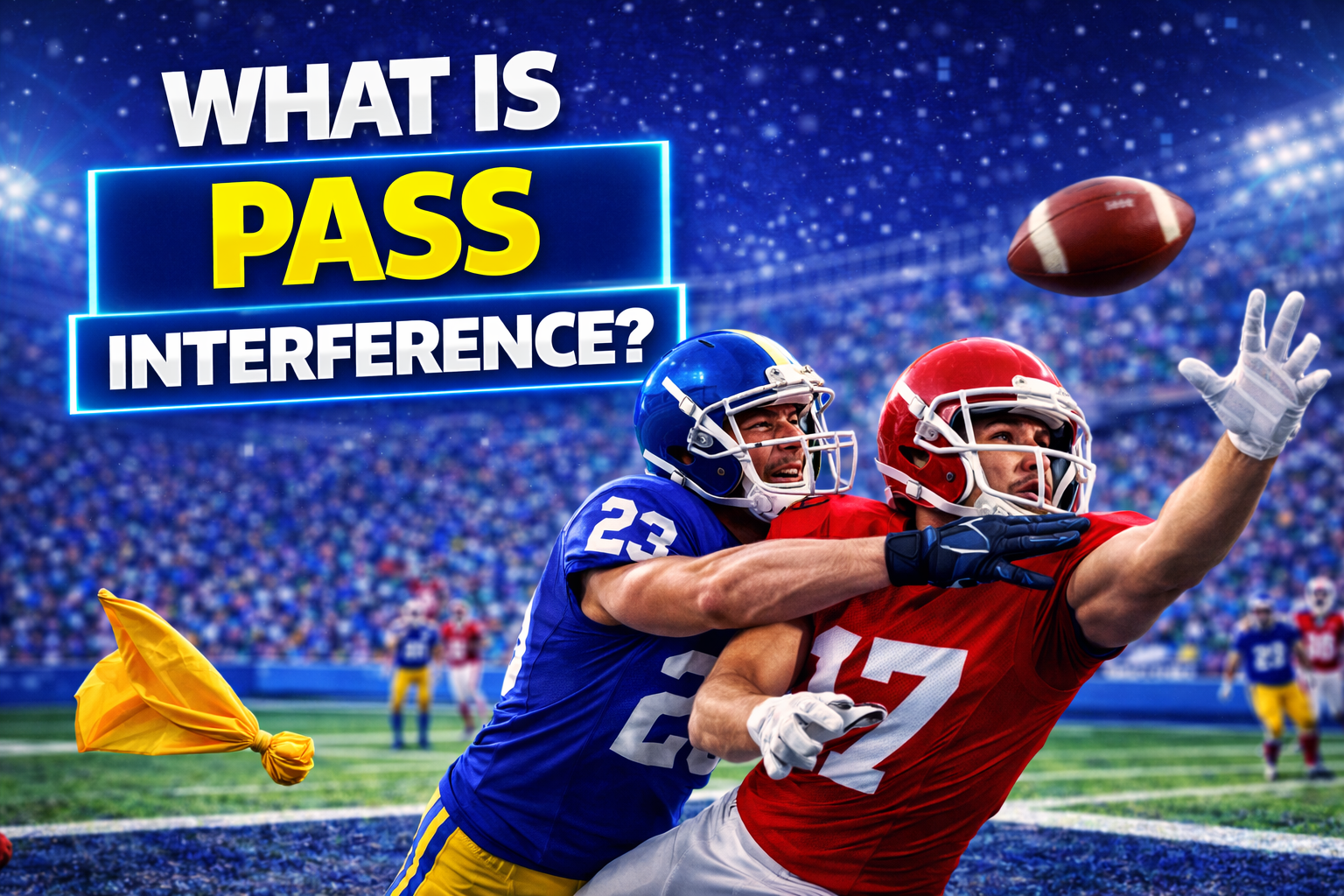
Pass interference occurs when a player illegally interferes with an eligible receiver’s opportunity to catch a forward pass while the ball is in the air.
There are two main types:
- Defensive pass interference (DPI) – committed by the defense.
- Offensive pass interference (OPI) – committed by the offense.
In most cases, people are referring to defensive pass interference, because it is called more often and usually results in a larger penalty.
When Can Pass Interference Occur?
Pass interference can only happen under specific conditions:
- A legal forward pass must be thrown.
- The ball must be in the air.
If the ball has already been caught or tipped, pass interference usually no longer applies.
What Counts as Defensive Pass Interference?
Defensive pass interference occurs when a defender significantly hinders a receiver’s ability to catch the ball before it arrives.
Common examples include:
1. Early Contact
If a defender hits or pushes the receiver before the ball gets there, and the contact prevents a fair catch attempt, it may be called pass interference.
2. Grabbing or Holding
Pulling the receiver’s arm or jersey so they cannot reach the ball.
3. Not Playing the Ball
If the defender does not turn around to locate the ball and makes contact that disrupts the receiver, officials may rule interference.
4. Cutting Off the Receiver’s Path
Deliberately stepping into the receiver’s path without attempting to play the ball can also qualify.
Not all contact is illegal. Incidental contact, where both players are making a legitimate attempt to catch the ball, is usually allowed.
What Counts as Offensive Pass Interference?
Offensive pass interference happens when the receiver or another offensive player illegally creates separation or blocks a defender before the ball arrives.
Examples include:
1. Pushing Off
If a receiver extends their arm to push a defender away to create space, that can result in a penalty.
2. Blocking Downfield Before the Catch
An offensive player cannot block a defender on a forward pass before the ball is caught.
3. Picking or Screening
Sometimes receivers run routes that intentionally block defenders to free another receiver. If done illegally, this can be offensive pass interference.
Step-by-Step: How Officials Determine Pass Interference
Pass interference is a judgment call. Officials must evaluate the play in real time.
Here’s how they think through it:
Step 1: Was There a Legal Forward Pass?
The pass must cross the line of scrimmage and not be tipped first.
Step 2: Was the Ball Catchable?
Officials consider whether the receiver had a realistic chance of catching the ball. If the pass is clearly uncatchable, interference may not be called.
Step 3: Was There Significant Contact?
Minor contact is common in football. Officials look for contact that clearly restricts movement or access to the ball.
Step 4: Who Initiated the Contact?
They determine whether the offense or defense caused the illegal restriction.
Because these decisions happen in seconds, controversy is common.
What Is the Penalty for Pass Interference?
In professional football:
- Offensive pass interference results in a yardage penalty against the offense and loss of down.
In college football:
- Defensive pass interference often carries a set yardage penalty rather than a spot foul.
These differences can significantly affect game strategy.
Why the Penalty Can Be So Large
One reason pass interference is debated is that defensive pass interference can result in a large gain — sometimes 30 or 40 yards.
The logic behind this rule is simple: without a strong penalty, defenders might intentionally interfere with receivers to prevent big plays. The severity of the penalty discourages intentional fouls.
In other words, the rule protects the integrity of deep passing plays.
Common Misunderstandings About Pass Interference
Misunderstanding 1: All Contact Is Illegal
Football allows physical contact. Incidental or simultaneous contact while both players attempt to catch the ball is legal.
Misunderstanding 2: The Defender Must Always Turn Around
Turning to locate the ball helps show the defender is playing the ball rather than the receiver. However, failure to turn alone is not automatically pass interference. It becomes an issue when combined with restrictive contact.
Misunderstanding 3: The Receiver Must Catch the Ball
Pass interference can be called even if the ball is not caught.
Misunderstanding 4: It Is Always Obvious
Many calls involve subtle hand placement or body positioning. That’s why slow-motion replays often reveal details that are hard to see live.
Strategic Impact of Pass Interference
Pass interference plays a major role in football strategy.
Deep Passing Game
Quarterbacks may attempt long passes knowing that even if incomplete, defensive interference could result in a large gain.
Defensive Technique
Defensive backs are trained to:
- Keep their eyes on the ball.
- Avoid grabbing.
- Time their contact precisely.
Risk Management
On certain plays, defenders must balance aggression with caution. Being too physical risks a penalty; being too cautious risks giving up a catch.
How to Recognize Pass Interference While Watching
If you’re new to football, watch for these signs:
- The defender contacts the receiver before the ball arrives.
- The receiver’s arm is clearly restricted.
- The defender never looks back for the ball and collides with the receiver.
- The receiver pushes off to create separation.
If you see a flag thrown as the ball arrives, there’s a strong chance it’s for pass interference.
Listening to the referee’s announcement clarifies whether it’s offensive or defensive.
Frequently Asked Questions
Can pass interference happen behind the line of scrimmage?
No. The rule applies only to forward passes that travel beyond the line of scrimmage.
What if the ball is tipped?
Once the ball is tipped by any player, pass interference restrictions usually end.
Can both players commit interference?
Officials typically penalize the player who initiates the illegal restriction. Rarely are both players penalized for interference on the same play.
Is it reviewable?
Depending on league rules, certain interference calls may be subject to limited review, though judgment calls are often upheld.
Why Pass Interference Is Sometimes Controversial
Pass interference is subjective. Two officials may interpret the same level of contact differently. Fans often disagree with calls because:
- Contact can look worse in slow motion.
- Camera angles may mislead.
- Emotional investment influences perception.
Despite debate, the rule remains essential for balancing offense and defense.
Practical Advice for New Fans
To better understand pass interference:
- Focus on the timing of contact.
- Watch whether the defender plays the ball.
- Notice whether the receiver’s movement is clearly restricted.
- Remember that some contact is legal.
With practice, you’ll begin to predict when a flag is likely before the referee even announces it.
Conclusion
Pass interference is a rule designed to ensure fairness during forward passing plays. It occurs when a player illegally restricts another player’s opportunity to catch the ball while it is in the air.
Though sometimes controversial, the rule plays a crucial role in maintaining competitive balance. It prevents defenders from simply obstructing receivers and prevents receivers from unfairly pushing off to gain separation.
Understanding pass interference helps you make sense of one of football’s most debated penalties. Once you grasp the logic behind the rule — protecting the right to fairly compete for the ball — the calls become easier to follow.
Football combines physicality with structure. Pass interference is one of the rules that keeps that balance intact.