If you’ve ever watched a football game, played one in school, or simply heard phrases like “a 100-yard drive” or “goal line stand,” you may have wondered what those distances actually mean. It sounds like a simple question, but the answer often causes confusion—especially for people new to the sport.
Football fields have very specific measurements that affect how the game is played, coached, and understood. Knowing these measurements helps fans follow the action more clearly, helps players understand positioning, and helps anyone planning a field get the dimensions right.
This article explains football field yardage step by step, clears up common misunderstandings, and gives you a complete, easy-to-understand picture—without assuming any prior knowledge.
Why Football Field Size Matters
The size of a football field isn’t arbitrary. Every rule—from first downs to scoring—depends on distance. Yard lines, end zones, and hash marks all exist to measure progress and ensure fairness.
Understanding the number of yards in a football field helps you:
- Follow plays more easily
- Understand penalties and field position
- Visualize strategy and momentum
- Avoid common misconceptions about the game
For beginners especially, field dimensions provide the foundation for understanding how football works.
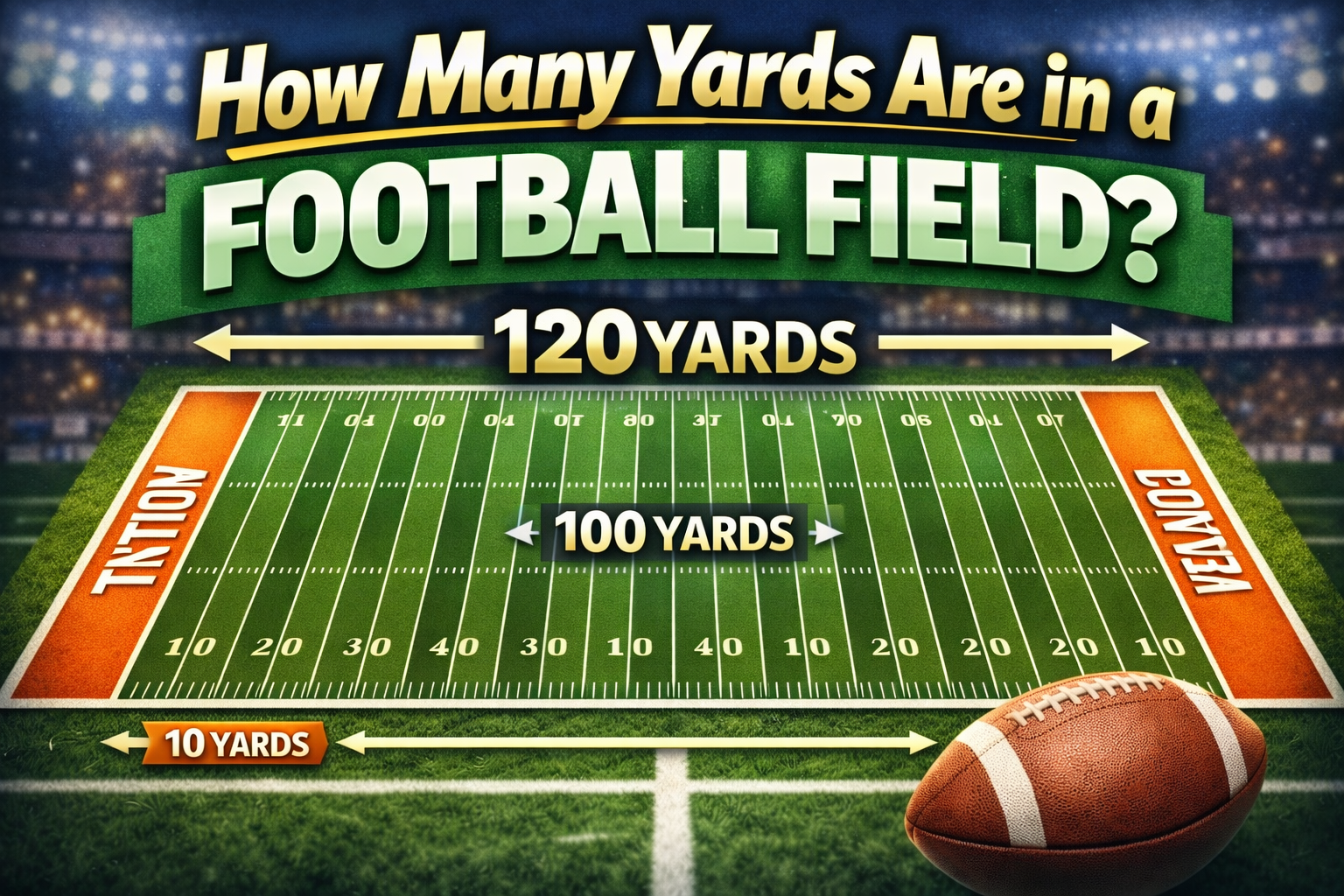
An American football field is 120 yards long from end to end.
This total includes:
- 100 yards of main playing field
- 10-yard end zone on each side
So when people say a football field is “100 yards,” they’re usually referring only to the main playing area, not the full length.
Breaking Down the Football Field by Sections
To fully understand the yardage, it helps to look at the field in parts rather than as one long strip.
The Main Playing Field (100 Yards)
The area where most of the action happens—between the two goal lines—is exactly 100 yards long.
This section includes:
- Yard lines marked every 5 yards
- Numbers marking every 10 yards
- Hash marks guiding ball placement
Teams must advance the ball across this 100-yard area to score.
The End Zones (20 Yards Total)
Together, both end zones add 20 yards to the field length.
End zones are where touchdowns are scored, and they play a major role in:
- Scoring rules
- Field positioning
- Defensive strategy near the goal line
Total Length: 120 Yards
When you include everything:
- 100 yards (main field)
- 10 yards (one end zone)
- 10 yards (other end zone)
You get 120 total yards from the back of one end zone to the back of the other.
How Wide Is a Football Field?
While this article focuses on yard length, width helps complete the picture.
An American football field is:
- 53⅓ yards wide (160 feet)
Width affects:
- Passing routes
- Defensive spacing
- Sideline plays
Even though width doesn’t change yardage length, it shapes how teams use those yards.
Yard Lines Explained Simply
What Are Yard Lines?
Yard lines are painted across the field to show distance from each goal line.
- They appear every 5 yards
- Numbers are marked every 10 yards
These markings help officials, players, and fans track progress.
Each half of the field mirrors the other.
- From one goal line, yard numbers increase from 10 to 50
- Past the 50, numbers decrease toward the opposite goal line
This design helps teams quickly identify how far they are from scoring.
Understanding First Downs and Yardage
One of the most important rules in football depends entirely on yard measurement.
The 10-Yard Rule
To earn a first down, a team must advance the ball 10 yards from the spot of the previous first down.
This is why:
- Chains are used on the sideline
- Yard lines matter so much
- Field measurements must be exact
Without consistent yard spacing, the game wouldn’t work properly.
Common Misunderstandings About Football Field Yardage
“A football field is only 100 yards”
This is partially true. The playing field is 100 yards, but the entire field is 120 yards.
“End zones don’t count as field”
They absolutely count. End zones are essential parts of the field and included in total length.
“All football fields are the same”
Most organized fields follow the same standard, but some youth or recreational fields may be smaller.
Differences Between American Football and Other Types of Football
Many people confuse American football with other versions of the sport.
Soccer (Association Football)
- Measured in meters, not yards
- Field length varies by competition
- Much larger playing area overall
Canadian Football
- Longer and wider field
- Larger end zones
- Different yard structure
Flag and Youth Football
- Shortened fields
- Fewer yards
- Adjusted for age and safety
When people ask about football field yardage, they are usually referring to American football, which uses the 120-yard standard.
Why Football Uses Yards Instead of Meters
American football developed using the imperial system, which includes yards and feet. As a result:
- Field measurements are based on yards
- Rules depend on yard increments
- Statistics are tracked in yards
This consistency keeps the game simple and uniform across levels.
How Field Size Impacts Strategy
The number of yards on the field directly influences how teams play.
Offense
- Long fields require sustained drives
- Short fields favor aggressive play
- Red-zone strategy changes inside the 20-yard line
Defense
- More space means more coverage responsibility
- Defenses tighten near the goal line
- Yardage awareness affects alignment
Special Teams
- Kickoff distances depend on field length
- Punt placement relies on precise yard judgment
- Field position is often more important than possession
Real-World Example: A 75-Yard Drive
When commentators say a team scored on a “75-yard drive,” it means:
- The offense started 75 yards away from the goal line
- They advanced the ball across most of the field
- The drive ended in the end zone
This language only makes sense when you understand the field’s total yard structure.
Practical Advice for New Fans and Players
For Fans
- Think of the field as 12 sections of 10 yards
- Use the 50-yard line as a mental midpoint
- Remember that end zones add extra length
For Players
- Learn spacing between yard lines
- Understand how close you are to scoring
- Practice visualizing distance during plays
For Coaches and Organizers
- Ensure fields meet regulation size
- Mark yard lines clearly
- Adjust dimensions appropriately for youth leagues
Frequently Asked Questions
How many yards are between goal lines?
There are 100 yards between the two goal lines.
How many yards are including end zones?
Including both end zones, the field is 120 yards long.
Are end zones always 10 yards?
In American football, yes. Other versions of football may differ.
Why is the 50-yard line important?
It marks the center of the field and helps determine field position quickly.
Why Accuracy in Field Measurement Matters
Precise yard measurement ensures:
- Fair play
- Accurate penalties
- Consistent records
- Proper strategy execution
Even small measurement errors could change the outcome of a game.
Conclusion
So, how many yards are in a football field?
The full answer is 120 yards total, including 100 yards of playing field and two 10-yard end zones.
Understanding this structure clears up confusion about scoring, field position, and game strategy. Whether you’re a new fan, a player, or just curious, knowing how a football field is measured helps you appreciate the game on a deeper level.
Football may look complex at first, but once you understand the field itself, everything else starts to make a lot more sense.


